
VoIP vs Traditional Phone System Cost: The True Comparison for Multi-Location Businesses

VoIP vs traditional phone system cost is one of the most searched questions in business telecommunications right now, and for good reason. Traditional phone lines now cost over $100 per line per month in many US markets while VoIP runs $15 to $30 per user per month with significantly more features included. For multi-location businesses still running legacy phone infrastructure, that gap represents a material and growing cost disadvantage.
The comparison has not always been this clear. In 2018 or 2019, the case for VoIP was strong but the savings were more incremental and the reliability concerns were more legitimate. In 2026, with AT&T having stopped accepting new POTS orders and actively decommissioning copper infrastructure, traditional phone line costs have jumped 200 to 400 percent while VoIP technology has matured to the point where reliability and call quality are no longer meaningful objections for most business environments.
This guide breaks down every cost category side by side so multi-location business owners and operations leaders can see exactly what they are paying for, what switching would actually cost, and what the net savings look like for a real business portfolio.
For context on how phone costs fit into your broader telecom environment, our guide on why your business phone bill keeps going up covers every reason costs have been increasing and what each one means for your bill right now.
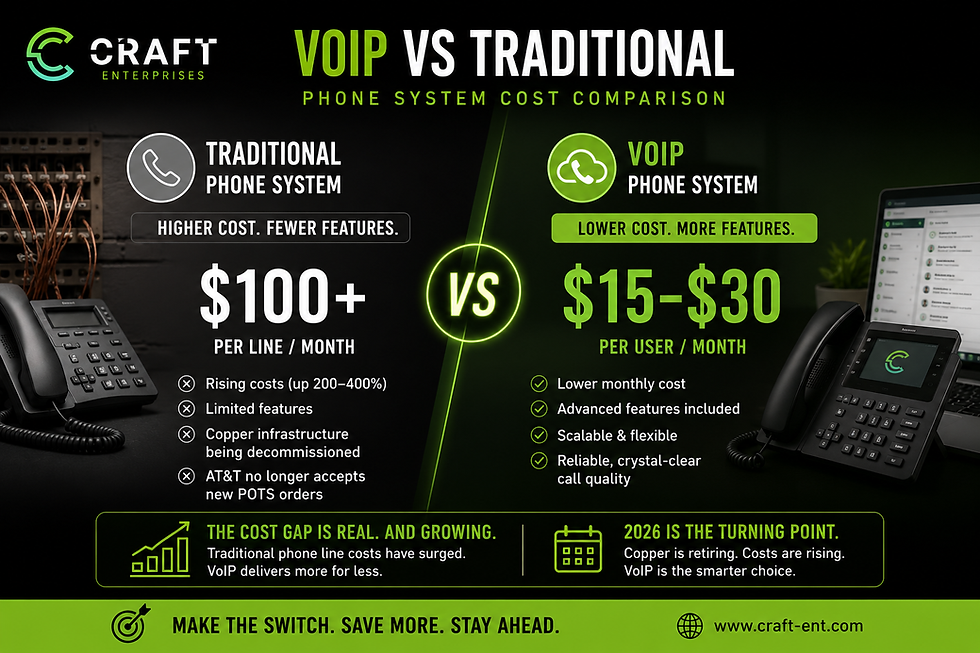
For a 10-location business with 50 voice users, switching from traditional phone service to VoIP saves an average of $8,500 per month. A strategy call is where we build that comparison specific to your location count, your current phone costs, and your existing infrastructure.
What Is the Real Difference Between VoIP and a Traditional Phone System?
A traditional phone system uses copper wire connections through the Public Switched Telephone Network, the PSTN, to carry analog voice signals between phones. It requires physical phone lines at each location, dedicated hardware on premises in the form of a PBX system for larger installations, and a carrier relationship for each line provisioned.
A VoIP system converts voice into digital data packets and transmits them over an internet connection. The phone service lives in the cloud. Users can make and receive calls from desk phones, computers, or mobile devices from any location with internet access. Adding or removing users requires a software change, not a physical line installation.
The operational difference between these two approaches matters because it directly drives the cost difference. Traditional systems require physical infrastructure at every location that must be installed, maintained, and eventually replaced. VoIP systems require only an internet connection and a device, both of which most businesses already have.
The Cost of Traditional Phone Systems in 2026
Per-Line Monthly Costs
Traditional POTS line costs have increased dramatically in 2026 as AT&T and other carriers accelerate copper network retirement. Lines that cost $40 to $50 per month in 2020 now cost $100 to $300 or more per month in many markets. Some specialty copper services have exceeded $2,700 per line per month where carriers are actively pushing businesses off their infrastructure.
For a standard business voice line in most US markets in 2026, expect to pay $80 to $150 per line per month on traditional copper service. PRI circuits, the digital equivalent used for larger phone systems, run $400 to $800 per month for a 23-channel circuit.
Hardware and Infrastructure Costs
On-premises PBX hardware for a traditional phone system runs $800 to $1,000 per user for initial installation in a mid-size business environment. A 20-person office installing a traditional PBX system is looking at $16,000 to $20,000 in upfront hardware costs before any monthly service fees. Each additional location requires its own hardware investment.
Desk phones for traditional systems run $100 to $400 per unit depending on the model. These phones are specific to the PBX platform and cannot simply be moved to a different system without replacement.
Maintenance and Support Costs
Traditional PBX systems require ongoing maintenance from specialized technicians. Annual maintenance contracts typically run 15 to 20 percent of the original hardware cost, meaning a $20,000 PBX installation carries $3,000 to $4,000 in annual maintenance costs on top of monthly line fees. Hardware failures require on-site technician visits which add both cost and downtime.
Long-Distance and International Calling Costs
Traditional phone systems charge per-minute rates for long-distance and international calls on top of the monthly line fee. For businesses with any volume of interstate or international calling, these per-minute charges add meaningfully to the total monthly cost.
The Cost of VoIP for Multi-Location Businesses in 2026
Per-User Monthly Costs
Business VoIP plans in 2026 run $15 to $55 per user per month depending on the features included and the provider. Entry-level plans at $15 to $25 per user cover standard calling, voicemail, and basic call management. Mid-tier plans at $25 to $40 per user add video conferencing, team messaging, CRM integrations, and call analytics. Enterprise plans at $40 to $55 per user include advanced features like AI-powered call routing, detailed reporting, and priority support.
For most multi-location businesses, a mid-tier plan at $25 to $35 per user provides everything needed for standard business communications across all locations.
Hardware Costs
VoIP-compatible desk phones run $80 to $250 per unit, significantly below the cost of traditional PBX phones. Many VoIP systems can also be used without dedicated desk phones entirely, using softphone applications on existing computers and mobile devices. For businesses willing to use soft phones, hardware costs can be reduced to near zero.
Setup and Implementation Costs
Cloud VoIP systems have minimal setup costs compared to traditional PBX installations. Most providers charge $0 to $500 for account setup and number porting. Implementation for a 20-location business that would have cost $100,000 or more in traditional PBX hardware and installation can be completed for under $10,000 in hardware and setup costs with a cloud VoIP platform.
VoIP vs Traditional Phone System: Side-by-Side Cost Comparison
Here is what the monthly cost comparison looks like for a 10-location business with an average of 5 voice users per location, totaling 50 users:
Traditional Phone System: Monthly line costs at $120 per line for 50 lines: $6,000 per month Annual PBX maintenance across 10 locations: $3,500 per month equivalent Long-distance charges estimate: $500 per month Total monthly cost: approximately $10,000 per month.
VoIP System: Monthly per-user cost at $30 per user for 50 users: $1,500 per month No dedicated line costs (runs over existing internet) Long-distance included in plan: $0 additional Total monthly cost: approximately $1,500 per month.
Monthly savings: $8,500 Annual savings: $102,000
This comparison is illustrative rather than a precise quote for any specific business, but it reflects the real magnitude of savings that multi-location businesses consistently find when they make a formal comparison between their current traditional phone costs and VoIP alternatives. Businesses switching to VoIP save on average 30 to 50 percent on their monthly phone bill, with some businesses achieving up to 50 percent reduction depending on their current infrastructure.
$102,000 in annual savings for a 10-location business. That is the real cost difference between traditional phone infrastructure and a properly structured VoIP system in 2026. A strategy call is where we build that number for your specific portfolio.
What the Savings Actually Look Like for a Multi-Location Business
The 30 to 50 percent savings figure is an average across businesses of all sizes. For multi-location businesses specifically, the savings opportunity is typically at the higher end of that range for two reasons.
The first is scale. Every percentage point of savings applies across all locations simultaneously. A 40 percent reduction in phone costs for a 20-location business is four times the dollar impact of a 40 percent reduction for a 5-location business.
The second is legacy infrastructure. Multi-location businesses that have been operating for more than five years and have never formally evaluated their phone system costs are the most likely to be on expensive per-line POTS or PRI infrastructure with contracts that have auto-renewed multiple times without a competitive review. These businesses typically see savings at the high end of the range when they make a full comparison.
A business spending $8,000 per month on traditional phone service across 15 locations that switches to VoIP at $2,400 per month saves $5,600 per month, $67,200 per year, from that single service category change.
The Hidden Costs That Change the Comparison
POTS Line Retirement Costs Changing Everything
The most significant development affecting this comparison in 2026 is the AT&T copper retirement. Traditional POTS line costs have already jumped 200 to 400 percent since 2020 as carriers reduce maintenance investment in copper infrastructure and reduce pricing competition. These costs will continue rising as more copper infrastructure is decommissioned through 2027 and 2029. Businesses that delay VoIP migration are not preserving the status quo. They are allowing traditional phone costs to continue increasing while the VoIP alternative stays flat or decreases.
Features Included With VoIP That Traditional Systems Charge Extra For
Traditional phone systems charge separately for features that VoIP plans include as standard. Auto-attendant and call routing on a traditional PBX requires additional hardware and programming. On a cloud VoIP platform it is a configuration in a web portal. Voicemail to email transcription, mobile apps for desk phone functionality, video conferencing, call recording, and team messaging are all standard inclusions in most business VoIP plans at no additional cost.
Scalability Costs
Adding a new user to a traditional phone system requires ordering a new physical line, waiting for installation, and potentially expanding PBX hardware capacity. Adding a new user to a VoIP system requires creating an account and shipping or downloading an app. For multi-location businesses that open new locations or expand headcount regularly, this scalability cost difference compounds significantly over time.
When Traditional Phone Systems Still Make Sense
Honest assessment: there are specific situations where traditional phone infrastructure is still the appropriate choice in 2026.
Locations with unreliable internet connectivity where VoIP call quality would be compromised. Facilities where life-safety systems require analog copper connections that are still in service. Businesses with specialized equipment that requires analog phone interfaces and where the cost of replacing that equipment exceeds the savings from VoIP migration.
For most multi-location businesses in urban and suburban US markets with reliable broadband internet at every location, these exceptions do not apply. The cost and feature comparison favors VoIP clearly in the 2026 environment.
What to Consider Before Switching to VoIP Across Multiple Locations
A multi-location VoIP migration is not simply a matter of cancelling phone lines and signing up for a new service. Done well, it is a structured process that protects business continuity and maximizes cost reduction.
The first step is a full inventory of every phone line and device at every location. This includes identifying which lines serve voice users, which serve building systems like alarm panels and elevator phones, and which are candidates for immediate disconnection as ghost lines. Not every line should be migrated to VoIP. Some should be disconnected entirely. Some alarm and elevator lines require cellular POTS replacement rather than VoIP.
Internet readiness at every location needs assessment before migration. VoIP call quality depends on available bandwidth and network quality. A location with marginal internet connectivity needs bandwidth review or a backup solution before VoIP is viable.
Number porting needs to be managed carefully. Every business phone number needs to be ported from the existing carrier to the new VoIP provider without interruption. Proper sequencing of the port and cutover process at each location prevents service gaps.
How Craft Enterprises Helps Multi-Location Businesses Evaluate and Transition
Craft Enterprises manages VoIP vs traditional phone cost evaluations as part of broader telecom consulting engagements for multi-location businesses. We audit every current phone line across all locations, identify which lines are candidates for VoIP migration, which require POTS replacement solutions, and which are ghost lines that should be disconnected, and model the full cost comparison for your specific environment.
We then manage the migration process, coordinating with VoIP providers and existing carriers, handling number porting, and ensuring every location transitions without service disruption.
The result is a phone system that costs 30 to 50 percent less per month, includes more features than the system it replaced, and is no longer dependent on copper infrastructure that is being actively retired.
The starting point is a strategy call where we review your current phone environment and build the cost comparison specific to your business.
Frequently Asked Questions: VoIP vs Traditional Phone System Cost
How much does VoIP cost compared to a traditional phone system?
Business VoIP plans run $15 to $55 per user per month in 2026. Traditional POTS lines cost $80 to $150 per line per month in most US markets, up from $40 to $50 in 2020. For a business with 50 voice users, VoIP at $30 per user costs $1,500 per month. The same 50 lines on traditional service cost $4,000 to $7,500 per month. The savings are substantial and the gap has widened significantly as traditional phone costs have increased with AT&T's copper retirement.
How much do businesses save by switching to VoIP?
Businesses switching to VoIP save on average 30 to 50 percent on their monthly phone bill. For multi-location businesses with legacy POTS or PRI infrastructure that has not been reviewed in several years, savings at the higher end of that range are common. Some businesses achieve savings of up to 50 percent or more, particularly those with high long-distance calling volumes or expensive PBX maintenance contracts.
Is VoIP reliable enough for a multi-location business?
Yes, in most business environments. VoIP call quality depends on internet connection quality and bandwidth. For locations with reliable broadband internet, VoIP call quality is equivalent to or better than traditional phone service. The main consideration for multi-location businesses is ensuring adequate bandwidth at every location and having a backup connectivity plan for locations where internet reliability is a concern.
What happens to alarm and elevator phone lines when switching to VoIP?
Alarm monitoring connections, elevator emergency phones, and fire panel lines cannot simply be migrated to VoIP in most cases because these systems require an analog phone interface. The appropriate replacement for these lines is a cellular POTS replacement solution rather than standard VoIP. A proper VoIP migration for multi-location businesses identifies and handles these lines separately from standard voice user lines.
How long does a VoIP migration take for a multi-location business?
A well-managed VoIP migration for a business with 5 to 15 locations typically takes 4 to 8 weeks from inventory assessment through full cutover at all locations. The timeline depends primarily on the number portability process with the existing carrier and the readiness of internet infrastructure at each location. Proper planning prevents service interruptions and ensures every location migrates cleanly.
Should a multi-location business manage a VoIP migration internally?
For businesses with dedicated internal telecom or IT resources, internal management is feasible with the right planning. For most multi-location businesses without dedicated telecom staff, working with a telecom consulting firm that manages migrations regularly reduces both risk and elapsed time. The inventory process, number porting coordination, and cutover sequencing across multiple locations require specific carrier knowledge that internal teams rarely have.


Comments